100 things every designer needs to know about people
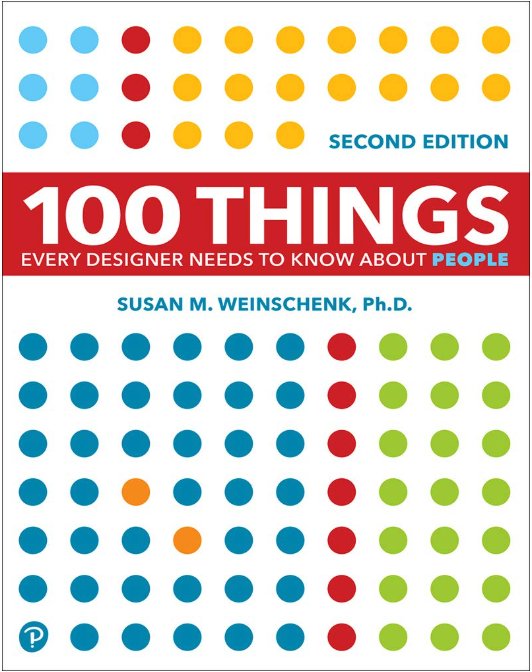
Susan Weinschenk —
Category: Diseño & Usabilidad (UX/UI)
100 Things Every Designer Needs to Know About People is an essential guide that bridges psychology and design. Susan Weinschenk transforms scientific principles into practical tools that help create more human, effective, and persuasive digital experiences.
What is it about exactly? This book brings together principles of psychology applied to digital design explained in a practical and accessible manner. Susan Weinschenk, a specialist in human behavior, translates decades of research into concrete insights that designers can directly apply to create more intuitive, persuasive, and effective experiences. Key Ideas: Design should be based on how people actually think, feel, and act, not on assumptions. Factors such as memory, attention, emotion, and motivation influence every interaction. Small details (colors, typography, placement) radically change user perception. Psychology is the bridge between experience and desired behavior. What you will learn from the book: Principles of visual perception that enhance understanding and navigation. How to capture and maintain attention in saturated digital environments. Strategies for designing persuasive messages and effective calls to action. The role of emotion in decision-making and loyalty. Practices to optimize user memory (remembering steps, rules, flows). What concepts can we apply to the iGaming industry: Limited attention: simplify screens and highlight the main action (play, deposit). Emotion as a motivator: integrate visual and narrative elements that generate excitement. Ethical persuasion: design clear CTAs in promotions and bonuses, avoiding confusion. Memory and consistency: make it easier for players to remember rules, accesses, and benefits. Inclusive design: consider cognitive and emotional limitations of different player profiles. Practical toolkit: 100 psychological principles explained with examples. Quick checklists to apply in design projects. Visual and content recommendations based on behavioral studies. Cases that show how small design decisions lead to significant results. Errors the book helps you avoid: Designing based on intuition instead of how people actually behave. Overloading the interface with unnecessary information. Ignoring the importance of emotion and motivation in loyalty. Creating messages that the user does not remember or understand. Summary 100 Things Every Designer Needs to Know About People is an essential guide that connects psychology and design. Susan Weinschenk transforms scientific principles into practical tools that help design more human, effective, and persuasive digital experiences. In the iGaming industry, this book provides keys to capture attention, generate emotion, and ethically motivate players, increasing satisfaction and retention in a highly competitive market.