Crossing the Chasm: Marketing and selling high-tech products to mainstream customers
Geoffrey A. Moore —
Category: Adquisición de Clientes & Marketing
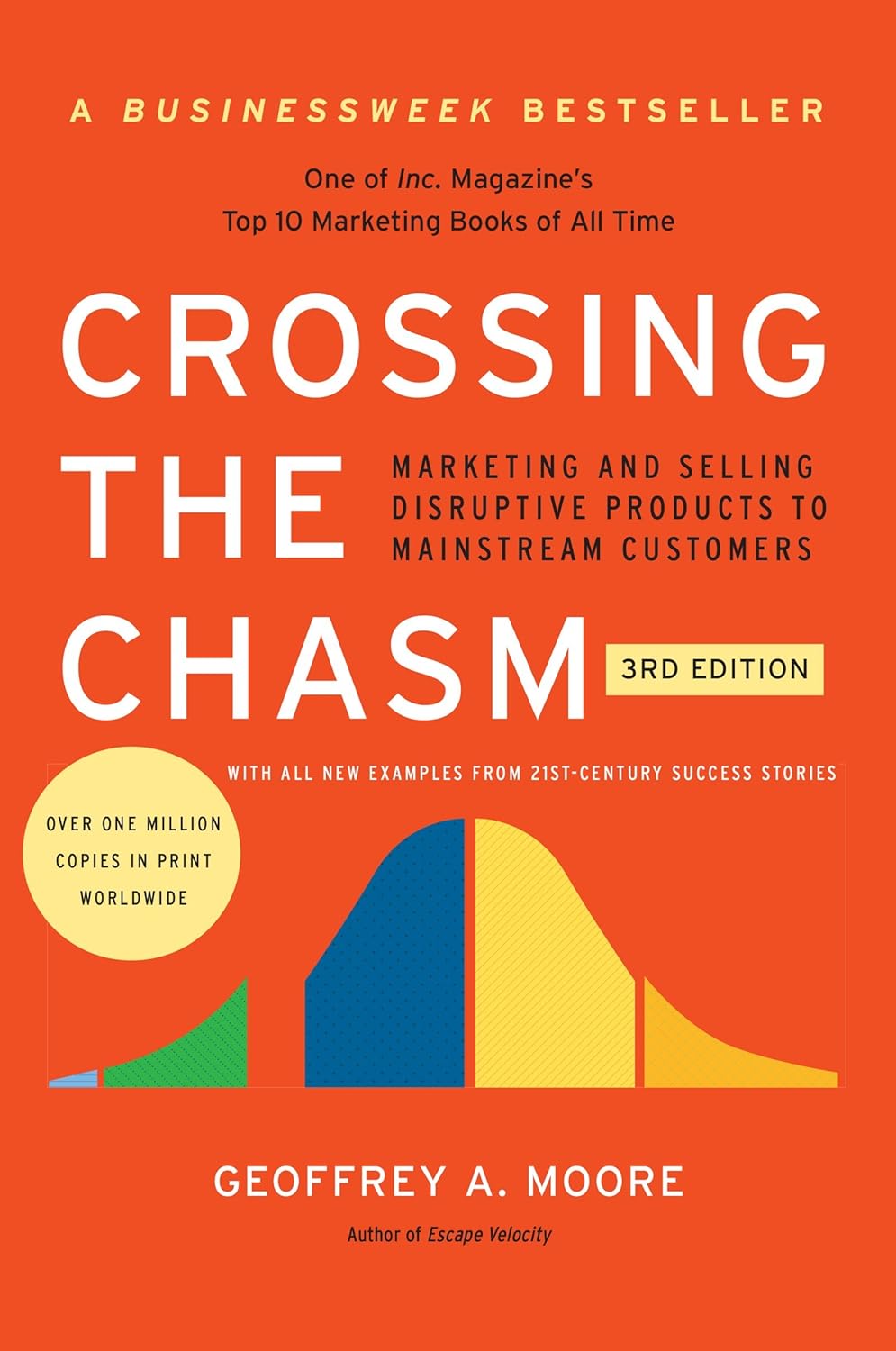
Crossing the Chasm: Marketing and Selling High-Tech Products to Mainstream Customers is the classic manual for transitioning from "those who love technology" to "those who just want results." Moore explains why so many startups experience rapid growth in their initial months only to crash when they attempt to scale, and he provides a concrete strategy for crossing the chasm that separates innovators/early adopters from the early majority (pragmatists).
What is it about exactly? The book is based on the Technology Adoption Life Cycle (TALC): innovators → early adopters → early majority → late majority → laggards. The “chasm” appears between early adopters (visionaries tolerant of failures, who buy promises) and early majority (pragmatists, who buy evidence). To cross it, Moore proposes: Choose a “beachhead”: a hyper-specific niche where you can quickly become number one (a vertical + use case + decision-maker role). No “for everyone” here. Whole Product: the core is not enough: everything the pragmatist needs for the promised outcome is required (integrations, support, data, services, partners, SLAs). Clear positioning: a simple statement: For [target customer] who [need], [product] is a [category] that [key benefit]. Unlike [main alternative], [differentiator]. D-Day Strategy: concentrate resources on winning that niche (marketing, sales, roadmap, partners). Be the unbeatable reference there before expanding. “Bowling Alley” (expansion through adjacencies): with reference customers from the niche, enter nearby segments (contiguous pins) and repeat the cycle. Channels and pricing for pragmatists: reliable routes (partners, integrators, VARs) and prices that reflect reduced risk and clear ROI. Key Ideas (in brief) Visionaries ≠ pragmatists: the former buy possibility; the latter buy proof. References > features: pragmatists are convinced by industry cases and peers saying “it works”. Winning a market = winning a niche: extreme focus beats dispersed budgets. Category before brand: define what you compete in and against what you will be compared. Partners as part of the product: “whole product” includes the ecosystem. Metric that matters: share of the chosen niche and number of public references. What you will learn from “Crossing the Chasm” How to truly segment (vertical + use case + role) and choose a winning beachhead. How to build the whole product that a pragmatic buyer demands. How to formulate a positioning that places your offer in the right (and budgeted) mind. How to orchestrate channels, pricing, and evidence to reduce perceived risk. How to move from the first niche to adjacencies without diluting focus. Typical mistakes the book helps you avoid Pursuing too many segments at once (“for everyone” = for no one). Selling demos to visionaries and expecting mass adoption without real success cases. Confusing roadmap with marketing (more features do not substitute for references). Underestimating the “whole product” (support, integration, compliance). Choosing the wrong category that leaves you off the buying shortlist. Operational toolkit (ready to use) Segmentation matrix: rows (verticals), columns (use cases); score size, pain, access, advantage. Choose 1 winnable cell. Beachhead sheet (1 page): critical problem, decision-maker role, existing budget, “compelling reason to buy,” competitors, and alternative to inaction. Whole Product checklist: core + integrations + data + migration + support + security/compliance + partners + ROI/SLAs. Positioning statement: complete the statement and test it in meetings with real customers. Reference program: 3–5 lighthouse customers with permission for logo, public case, and peer calls. 90-day D-Day plan: campaigns, sales/channel enablement, 2–3 critical integrations, 1 niche-oriented release, quota and reference goals. Why it remains essential Because many innovations die in the chasm between technical enthusiasm and pragmatic purchase. This book provides the map to turn initial traction into repeatable business: focus, whole product, evidence, and orderly expansion. Technology changes; the psychology of the buyer does not change as much—and that is where Moore continues to be relevant. “Crossing the Chasm” is pure strategy: choose, focus, and demonstrate. If you are growing “a little everywhere,” you are losing. Win a niche with a whole product and customers who speak for you; then, and only then, cross to the next. That is the way to turn innovation into market.
Related videos
- Sell Disruptive Products with CROSSING THE CHASM by Geoffrey A. Moore
- Crossing The Chasm - Disruptive Innovation - Technology Adoption Life Cycle
- Diffusion of Innovation Theory: The Adoption Curve
- Why innovation is all about people rather than bright ideas | Alexandre Janssen | TEDx
- The art of innovation | Guy Kawasaki | TEDx