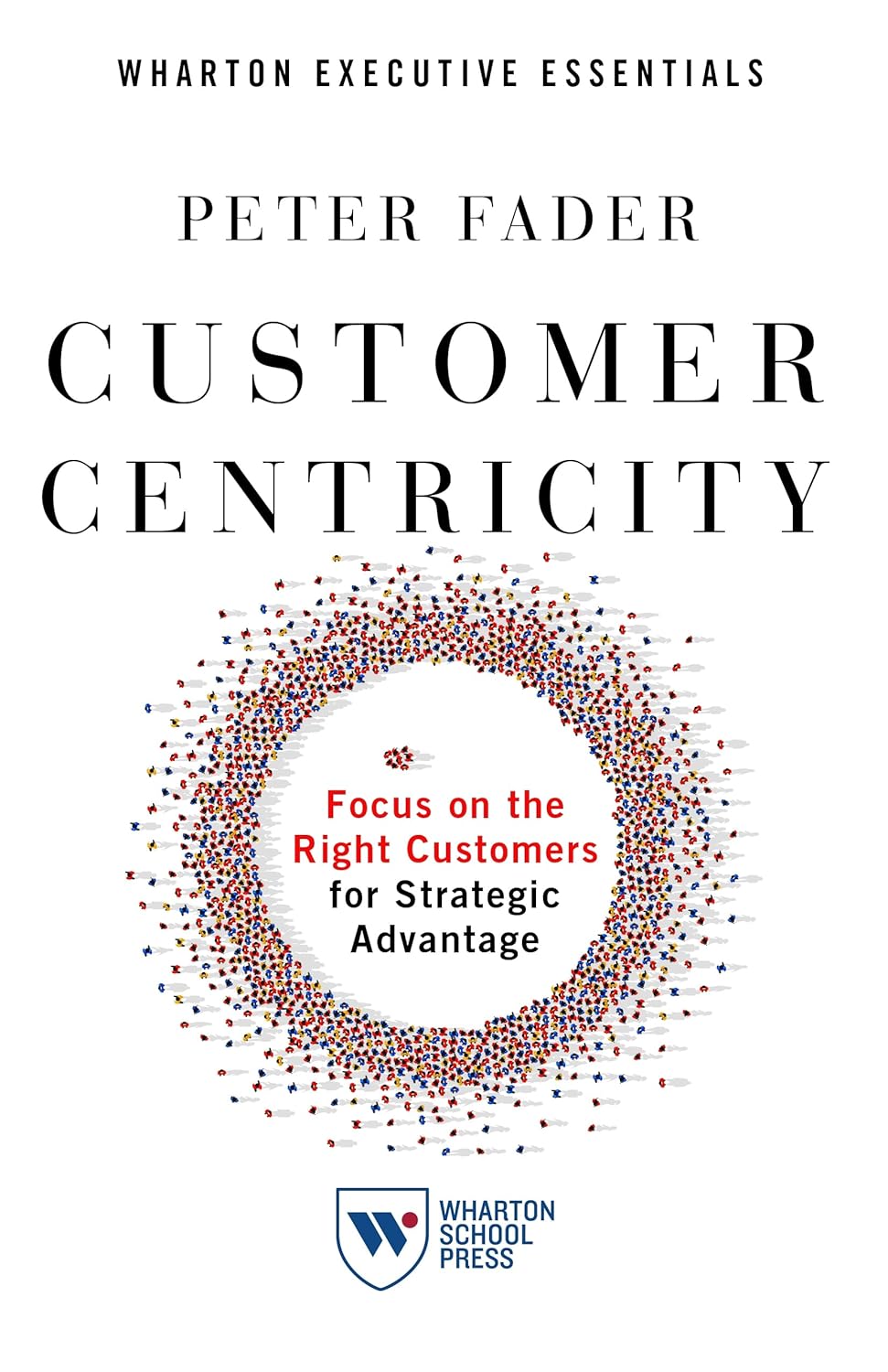
Customer Centricity: Focus on the Right Customers for Strategic Advantage
Peter Fader —
Category: Fidelidad del Cliente & Retención
Customer Centricity is an antidote to the notion that "all customers matter equally." Fader—an academic and co-founder of Zodiac/Theta—demonstrates that customers are heterogeneous and that sustainable growth comes from disproportionately investing in those with the highest customer lifetime value (CLV). It’s not about being “nice” to everyone; it’s about designing the company around the right customers.
What It’s About Product-centric vs. customer-centric: instead of launching more products into the market, start with who is worth more to you, why, and how to serve them better than anyone else. Heterogeneity and CLV: demand is not uniform; a few customers explain a large part of future cash flow. Prediction > description: segment by expected future behavior (purchases, frequency, spending), not just by demographics or historical RFM. Differential resource allocation: acquisition, retention, development, and reactivation are planned based on expected incremental value, not by “response rate.” Key Ideas (in brief) Not all customers deserve the same treatment (nor the same cost to serve). CLV is a financial variable, not a marketing KPI: it guides roadmap, pricing, service, and M&A. Well-calibrated simple models (e.g., BG/NBD + Gamma-Gamma) predict value better than descriptive dashboards. Surgical retention: fewer mass campaigns, more interventions with proven uplift. Customer Equity: the sum of future CLVs is the true “value of the customer-oriented company.” What You Will Learn from the Book How to estimate CLV (frequency × value × margin × survival – CAC) using simple probabilistic models. How to prioritize customers, channels, and offers by incremental value. How to design customer portfolios (acquire, cultivate, protect, let go). How to measure customer-based corporate valuation and translate marketing into cash flow. How to avoid biases from “vanity metrics” (opens, clicks, followers) that do not drive value. Practical Toolkit: 1) Express Customer Base Audit (2 weeks) Cohorts: monthly sign-ups, D30/D90/D365 retention, and ARPU by cohort. Concentration: % of revenue and margin by customer decile (how “top-heavy” is your business?). Cost to serve: tickets, returns, discounts; calculate net margin per customer. Channel mix: CAC and payback by source (paid/owned/referrals). 2) Minimum Viable Predictive CLV Frequency: BG/NBD (expected repurchases). Monetary: Gamma-Gamma (expected spending per purchase). Margins and costs: include variable and service costs. Horizon: 12–24 months (depending on cycle). Decision: only invest where CLV–CAC > 0 with a margin of safety. 3) Action Matrix by Expected Value Protect (top decile): premium SLA, prioritized roadmap, value-based pricing. Develop (high medium): cross/upsell with evidence of lift. Optimize (low medium): automate service, seasonal offers; do not over-invest. Let go (negative): stop subsidies; protect margin and reputation. 4) Uplift > response Experiment with uplift propensity models (who does your action change?) rather than just “purchase probability.” Measure incrementality vs. control, not just response rate. 5) Metrics That Truly Matter Customer Equity (sum of future CLV). LTV/CAC by cohort and channel. Net Dollar Retention / Earned Growth (growth “earned” through retention and referrals). High-value churn (not total churn). Payback and margin at 12/24m. 6) Governance and Culture CLV Owner (finance + growth). Bonuses tied to value (retention/margin by cohort), not gross volume. Privacy and fairness: personalize with consent and avoid undue discrimination. Errors the Book Helps You Avoid Treating very unequal customers the same. Pursuing acquisition volume with negative unit economics. Designing loyalty programs “for everyone” that subsidize those who do not need it. Measuring success by engagement instead of future cash flow. Doing “personalization” without economic direction or ethical safeguards. “Customer Centricity” is not generic empathy: it is financial strategy applied to the customer. By centering your organization on the right customers, you allocate capital better, reduce commercial waste, and build an asset that compounds: the customer base that pays, stays, and grows with you. That is the true shortcut to leadership.
Related videos
- Customer Centricity: Wharton Professor Peter Fader on Prioritizing Relationships in Business
- Customer Centricity Essentials
- Professor Peter Fader - How Can Customer Centricity Be Profitable
- The customer isn't always right, but some customers are better than others | Peter Fader | TEDx
- Customer-Centric Evolution: The power of feedback | Elina Kakourou | TEDx