Positioning: The Battle for Your Mind
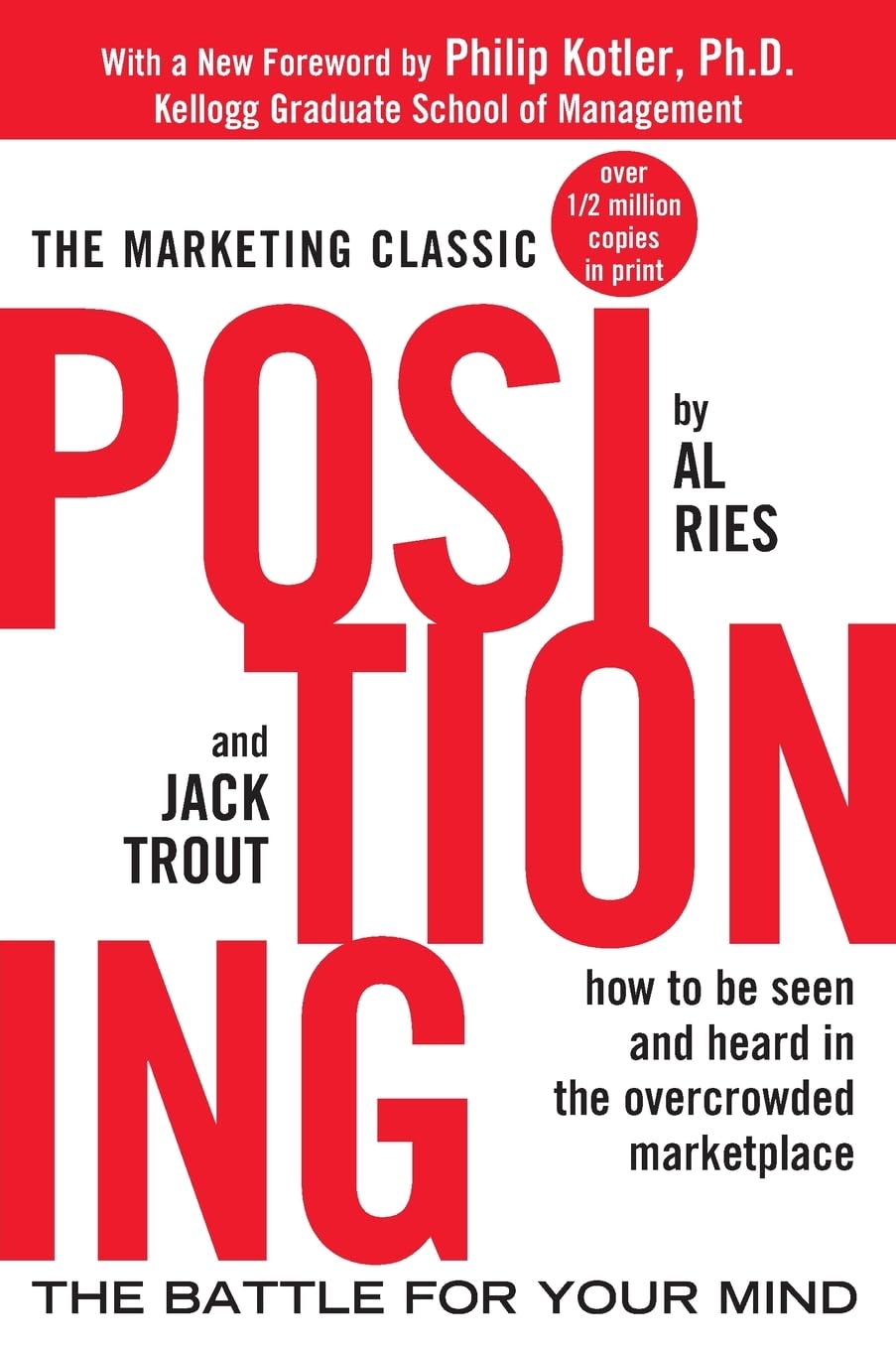
Al Ries & Jack Trout —
Category: Adquisición de Clientes & Marketing
Positioning changed marketing by asserting that you do not compete on the shelf; you compete in the mind. People do not compare endless options: they use mental ladders (top-of-mind by category) and shortcuts. Positioning is about choosing a simple box that you can occupy (or create) in that mind, and then defending it with discipline.
What is it about exactly The mind is saturated: any complex message gets lost. The category rules: first define the category; then your place in it. Being first helps: those who arrive first in the mind tend to stay; if you are not first, create a subcategory that you can lead. Re-position the competitor: frame the rival so that, by contrast, your place becomes evident. Focus or die: line extensions dilute meanings; the power of a brand lies in one word. Key ideas (in brief) Strategy = renunciation: you cannot be “everything to everyone.” Simplicity: one unique idea per brand. Consistency: positioning = repeated promise over the years. Name and category: a good name reinforces the idea and the competitive frame. Social proof: in mature categories, credibility sustains the position (numbers, customers, cases). What you will learn from “Positioning” How to define your category (and, if necessary, create a sub-category where you are #1). How to write a clear and defendable positioning statement. How to reduce your promise to one word/idea that people can remember. How to decide what NOT to do (and which products/claims to discard) to avoid dilution. How to use re-positioning (framing the rival) ethically and precisely. Typical mistakes the book helps you avoid “We are for everyone” → no one remembers anything. Extending the brand to anything out of growth anxiety. Changing the message every quarter (breaks accumulated memory). Poorly defining the category (you will be left out of the mental “shortlist”). Communicating multiple attributes instead of one idea. Practical toolkit (ready to use) 1) Positioning statement For [specific segment] that [need/tension], [Brand] is [category/frame] that [key differentiator], because [proof/reason to believe]. Simplicity test: read it aloud to someone outside the sector; if they don’t repeat it in 10 seconds, it’s complex. 2) “Mental scale” matrix List your category (the one your customer buys, not the one you dream of). Note the customer’s 3 top-of-mind real competitors. Decide: Can I be #1? If not, create a subcategory (e.g., by audience, use, channel, format, price, philosophy). 3) One word What is the word/idea you want to own? (fast, simple, safe, artisanal, open, etc.) Filter: if someone else already owns it, look for a counter or a legitimate adjacency. 4) Re-positioning the rival (ethically) Frame: “When you seek [result], [rival] is focused on [X]; we are focused on [Y].” Avoid empty attacks; use verifiable contrasts. 5) Name & category Name: easy to pronounce, write, and remember; that suggests the idea. Category in copy: name it explicitly (“we are ___ for ___”), do not leave it to assumptions. 6) Perceptual map (quick) Axes with two relevant attributes for the customer (not for you). Locate yourself and competitors; look for empty quadrants with demand. 7) Anti-dilution guide Every new initiative must reinforce the chosen word. If a new offer contradicts your position, create another brand or say no. Useful templates Position one-liner: “[Brand] is the [category] [word/idea] for [segment], that achieves [result] without [pain].” Elevator pitch (30–45 s): Category and customer: “We are the [category] for [segment].” Tension: “Today [specific problem]…” Unique idea: “We focus on [word/attribute]…” Evidence: “With [brief proof]…” Closing: “That’s why we are the option for [situation].” Consistency checklist (monthly): Does my website, demo, and sales repeat the same essential phrase? Does the content reinforce one idea or add noise? Does the PR/ads state in which category I compete? Does any recent launch dilute the word? (if so, correct or separate the brand) How to choose and defend your position (6-step process) Quick research: 15-min interviews with 10–15 customers → what category they use and who their top-of-mind competitors are. Niche/category selection: where you can be real #1 (not aspirational). Draft the statement and the word. Message testing A/B (headline, subline, proof) until people repeat it without your help. Evidence: cases, metrics, comparisons; without this, the place is lost. Discipline: everything new goes through the filter “Does it reinforce the word?”. Why it remains relevant Because the saturation of options is greater than ever, and human memory has not changed. Winning today is about choosing a small, clear battle, naming it, and defending it without distraction. Positioning gives you the map: category → unique idea → name → proof → consistency. If you follow it, you enter the mind; and from there, everything else costs much less.
Related videos
- Positioning: The Battle for Your Mind, by Al Ries & Jack Trout - Animated Book Summary
- Positioning: The Book That Will Transform Your Marketing Game
- BrandDIYGroup Book Review: Positioning by Al Ries and Jack Trout
- How to brand anything | Youri Sawerschel | TEDx
- 5 Steps to Building a Personal Brand You Feel Good About