Scrum: The art of doing twice the work in half the time
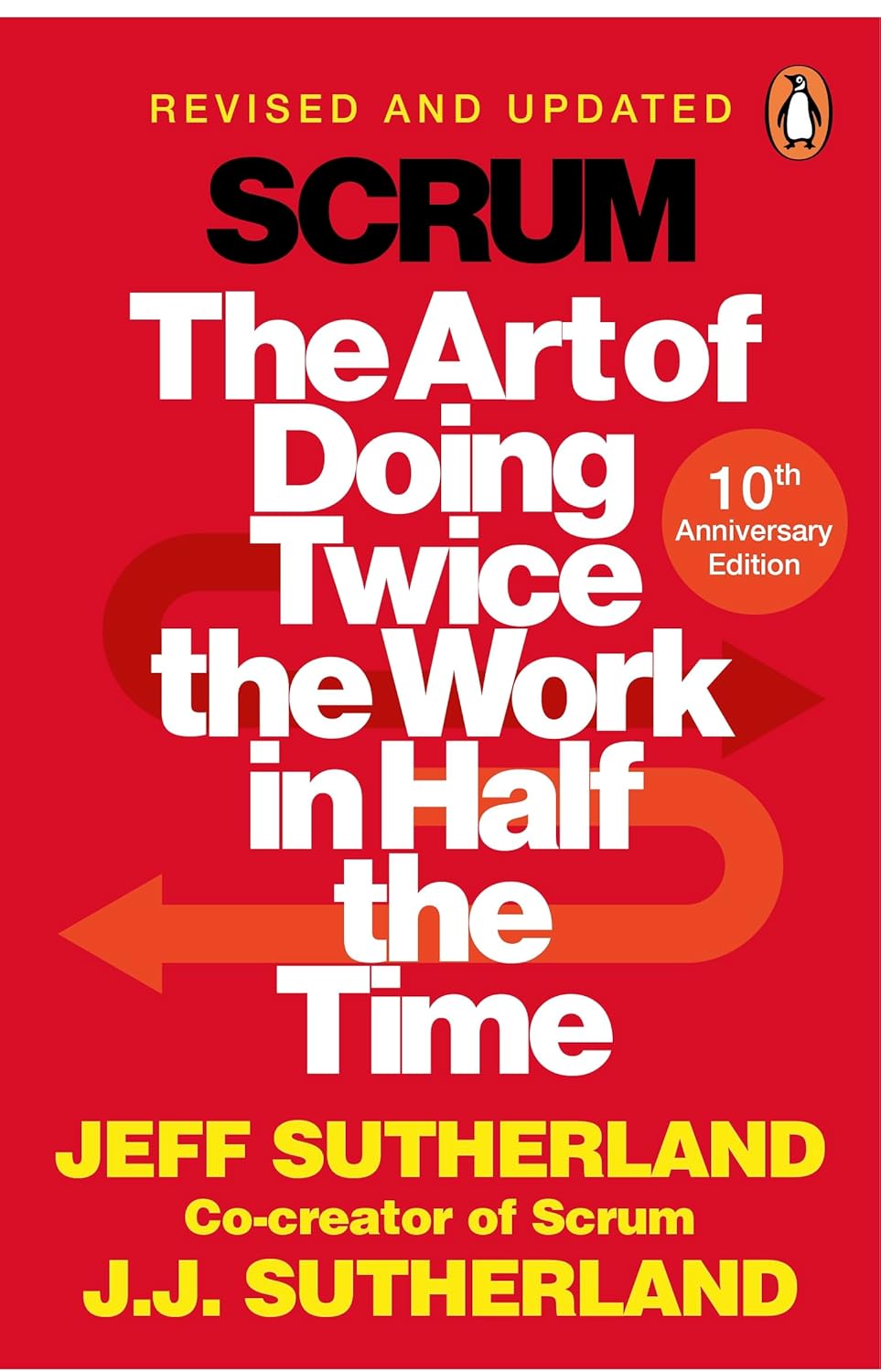
Jeff Sutherland, JJ Sutherland —
Category: Empresas Ágiles & Management Moderno
Scrum is a manifesto-book on how to deliver value sooner, better, and with less waste. Jeff Sutherland (co-creator of Scrum) narrates the origin of the framework, its minimal rules, and—above all—how work changes when we measure progress by value delivered, not by hours spent. The focus: small teams, short cycles, radical transparency, and continuous learning.
What is it about exactly? Scrum is based on empirical management: transparency → inspection → adaptation. Instead of planning everything in advance, the team works in Sprints (time-boxed iterations) and produces a potentially deliverable increment at the end of each one. The cadence and rules are deliberately simple so that the energy goes into solving real problems: Roles: Product Owner (prioritizes value) Scrum Master (removes impediments and cares for the process) Development Team (cross-functional, self-organized). Events: Sprint (1–4 weeks) Sprint Planning (what value we will deliver and how) Daily Scrum (15 min to synchronize and identify impediments) Sprint Review (demonstration and real feedback) Retrospective (improvement of the work system). Artifacts: Product Backlog (ordered list by value) Sprint Backlog (Sprint plan) Increment (completed work). Key supports: Definition of Done Definition of Ready burndown/burnup impediment log relative estimation (story points) velocity. Practical principles: Strict timeboxing prioritize by value and risk deliver early (do not accumulate “almost done” work) stable teams and continuous improvement. Sutherland also suggests metrics such as team happiness and scaling practices (Scrum of Scrums) when there are multiple teams. What you will learn with “Scrum” To define value and order the backlog by impact (not by “who shouts the loudest”). To break down work vertically (complete user stories), avoiding isolated “mini-tasks” that do not generate value on their own. To deliver useful increments in weeks, with quality built-in (Definition of Done). To reduce uncertainty with short cycles and frequent feedback. To make the invisible visible: impediments, bottlenecks, technical debt, risks. To improve the system every Sprint (not just the feature). How to apply “Scrum” in iGaming The book is not written for gambling; below is a practical application of the framework to the regulated environment of iGaming (payments, KYC, RG, licenses, country markets). 1) Team structure and focus by journey Squads by critical flow: Onboarding & KYC, Deposits, Withdrawals & Cashout, Sportsbook & Odds, Responsible Gaming, Affiliation & CRM. Each squad has a Product Owner with value objectives (e.g., “time to first withdrawal”, “CES post-KYC”) and a Scrum Master who removes obstacles (suppliers, legal, data). 2) Definition of Done compatible with regulation Includes, at a minimum: Legal and compliance review by country, accessibility, telemetry/observability, performance under load, feature flags by jurisdiction, rollback plan, approved translations, update of T&Cs and support documentation. Without DoD, there is no “done”, only code in the branch. 3) Prioritization by value and risk (Product Backlog) Order by impact on player and business: time to first withdrawal, KYC completion rate, adoption of limits, NPS/CES, reduction of claims, regulatory risk. Alternate value stories with technical debt and risk to avoid mortgaging the future. 4) Sprint Planning with a clear Sprint Goal Examples of 2-week goals: “Reduce time to first withdrawal by −20% for new players in Country A through real-time tracking and simplification of steps.” “Increase KYC completion by +15 pp with guided capture and sixth-grade texts.” 5) Daily that unlocks (not a report) Three useful questions: What brings us closer to the Sprint Goal? What impediment is holding us back today? What adjustment will we make to the plan? The Scrum Master leaves the meeting with a list of impediments and owners to resolve them that same day. 6) Review with real users and key areas Demonstration of the Increment to Support, Risk/Compliance, Payments, Legal, Country and—when possible—real users. Gather actionable feedback (not abstract opinions) and decide whether the feature goes to controlled experiment (A/B) or to rollout. 7) Retrospective with “Five Whys” Select 1–2 process improvements per Sprint (e.g., reduce WIP, improve handoffs with Legal, agree on “quiet hours” for focus). Small and verifiable actions for the next Sprint. 8) Continuous delivery and safe scaling Feature flags by country, canaries, dark launches, observability and alerts before increasing traffic. Weekly Scrum of Scrums to coordinate dependencies between squads (e.g., changes in PSP affecting Withdrawals and Support). Applied mini-cases A) Withdrawals Sprint Goal: real-time tracking of status + prioritized queues by tier. DoD: load testing, localized messages, rollback plan, and training for support. Outcome at Review: CES post-withdrawal drops from 2.6 to 1.8; rollout approved in Country A. B) Frictionless KYC Stories: guided capture, OCR, single checklist, clear texts, visible progress. Sprint Metric: +12 pp in KYC completed, −35% help tickets. Retro: agree on “definition of ready” (DoR) so that Legal participates before development. C) Responsible loyalty program Stories: simple “earn & burn” rules, SLA as a benefit, preference center. DoD: regulatory review, redemption analytics and limits, clear communication of expiration. Outcome: healthy redemption increase and fewer complaints. Minimum toolkit: Sprint Goal template (outcome + metric + segment/country). DoD and DoR specific to iGaming (regulation, flags, support, translations). Impediment log with owner and date. Visible Burndown/Burnup and boards by journey. Guide for vertical stories (user, value, measurable acceptance criteria). Agenda for Scrum of Scrums (risks, dependencies, needed decisions). Team metric: velocity, throughput, lead time and happiness (brief pulse at the end of the Sprint). “Scrum” is not just a process: it is a mindset shift. You move from “completing tasks” to delivering early and continuous value, with transparency and learning. In iGaming—where every detail affects trust, regulation, and experience—this discipline turns objectives like clear KYC, flawless withdrawals, and responsible gaming into real increments every few weeks. Fewer promises, more deliveries. And better, every time.
Related videos
- Scrum: How to do twice as much in half the time | Jeff Sutherland | TEDx
- The Battle for Your Time: Exposing the Costs of Social Media | Dino Ambrosi | TEDx
- Agile en la vida diaria | Xavier Hidalgo | TEDx
- The single biggest reason why start-ups succeed | Bill Gross | TED
- Scrum in 20 mins... (with examples)