The DevOps Handbook: How to create world-class agility, reliability, and security in technology organizations
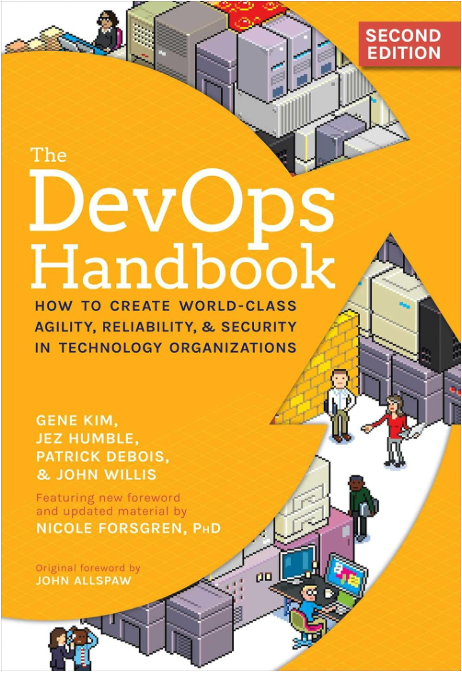
Gene Kim, Jez Humble, Patrick Debois, John Willis —
Category: Empresas Ágiles & Management Moderno
The DevOps Handbook is an essential manual for organizations seeking to combine speed, quality, and security in technological environments. Kim, Humble, Debois, and Willis demonstrate how DevOps transforms not only software delivery but also the organizational culture towards collaboration and continuous improvement.
What is it about exactly? This book is the definitive guide on DevOps, an approach that integrates development and operations to create more agile, reliable, and secure technology organizations. The authors, pioneers of the DevOps movement, demonstrate how to apply principles, practices, and tools to accelerate software delivery, improve quality, and respond quickly to business needs. Key Ideas: DevOps breaks down silos between development, operations, and business. The key lies in the three ways: Flow: accelerate the movement of code to production. Feedback: create fast and continuous feedback loops. Continuous learning and experimentation: foster improvement and resilience. Automation, continuous integration, and frequent deployment are core practices. Security and reliability must be integrated from the start, not at the end. What you will learn from the book: Fundamental principles of DevOps and how to implement them. Practices of continuous integration, continuous delivery, and automation. Strategies to improve collaboration between development and operations teams. How to measure the success of DevOps with flow, stability, and learning metrics. Real-world cases of companies that transformed their performance through DevOps. What concepts can we apply to the iGaming industry: Agility in launches: implement new features (bonuses, features, games) with short and secure cycles. Reliable platforms: ensure constant uptime and low latency in live betting. Integrated security: protect player data and transactions from the design phase. Automation: continuous deployments that reduce human errors and accelerate time-to-market. Continuous learning: use performance metrics to constantly improve product and operations. Practical Toolkit: The “Three Ways” as a framework for implementing DevOps. Best practices for CI/CD, monitoring, and automation. Key metrics: lead time, deployment frequency, MTTR (Mean Time to Recovery). Application cases in leading technology companies. Errors the book helps you avoid: Treating DevOps solely as a set of tools, without cultural changes. Maintaining silos between development, operations, and business. Sacrificing security or quality for speed. Not measuring results and missing learning opportunities. Summary The DevOps Handbook is an essential manual for organizations seeking to combine speed, quality, and security in technological environments. Kim, Humble, Debois, and Willis show how DevOps transforms not only software delivery but also the organizational culture towards collaboration and continuous improvement. In the iGaming industry, where agility, reliability, and security are critical, applying these principles means launching products faster, maintaining stable platforms, and building trust with players and regulators.
Related videos
- The DevOps Handbook: Streamline Your Development Process | Book Review
- Is Technology Our Savior — or Our Slayer? | Ruha Benjamin | TED
- Will technology shape our future or will we | Deborah Nas | TEDx
- The single biggest reason why start-ups succeed | Bill Gross | TED
- How would AI impact the future of DevOps