A book redefines illegal online gambling as a multi-offense crime
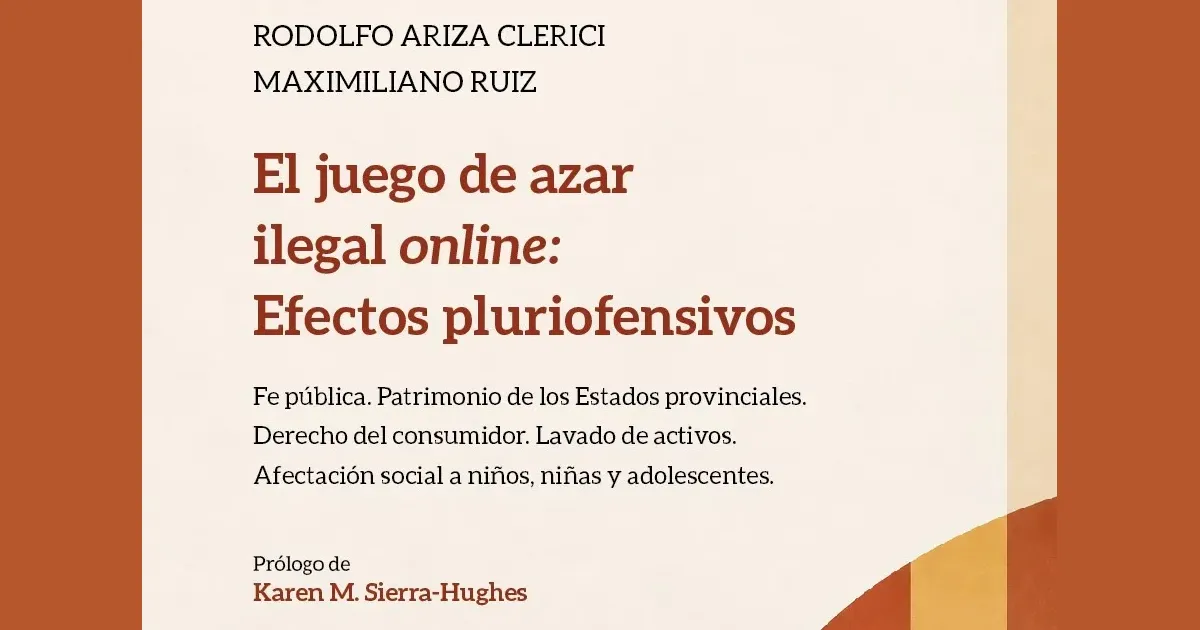
Looking at illegal gambling solely through the lens of the penal code is no longer sufficient. This is the thesis put forth by Rodolfo Ariza Clerici and Maximiliano Ruiz in the expanded version of their academic work, now published under the title "El juego de azar ilegal online: Efectos pluriofensivos" (Illegal Online Gambling: Multi-Harmful Effects), with a prologue by Karen Sierra-Hugues.
The "multi-harmful" aspect of the title points to something specific. For the authors, unlicensed offerings simultaneously impact five fronts: public health, consumer rights, personal data protection, state revenue loss, and the framework preventing money laundering. None of these fronts, individually, is enough to describe the problem.
The contrast with the first edition highlights how much the landscape has changed. In 2020, the sector's goal was to establish a regulatory framework, and the pandemic acted as a catalyst: confinement drove a massive migration to digital platforms that overwhelmed existing rules. Six years later, the problem has evolved: some jurisdictions have already regulated and consolidated their markets, but they coexist with a clandestine capture that has become more sophisticated, has no fixed address, and crosses borders.
The first doctrinal contribution is one of classification. The work posits that online gambling is already a legal category with a life of its own: it has a regulatory system designed for digital environments, definitions that do not coincide with those of land-based gambling, and a shared objective, which is to protect the user and bring order to the market.
From there, the analysis delves into what is currently happening in the region's courts. The authors show how the classic figure of illegal gambling has changed, with Article 301 bis of the Argentine Penal Code as a reference, and describe complex hierarchical structures that rely on networks of cashiers and administrators responsible for moving liquidity far from any supervised financial channel.
The chapter on affiliation addresses an unresolved issue. Streamers, influencers, and tipsters attract bettors through shared monetization schemes, and the book argues that a definition of the criminal and administrative responsibility of these intermediaries cannot be further postponed when they connect users to an unlicensed platform.
Child cyber-gambling addiction is presented as a socio-health priority rather than a regulatory matter. The text describes children and adolescents excessively exposed to digital stimuli, welcome bonuses, loot boxes, and free games that act as bait and ultimately modify their behavior.
The inventory of new modalities gives an idea of how much the market has evolved in six years. It includes fantasy sports and esports, live game shows with presenters, crypto casinos, and prediction markets, in addition to the need to specifically criminalize sports match-fixing. And the update projects future risks: artificial intelligence embedded in recommendation algorithms and in predicting tipsters, the movement of digital assets, the white label model, and everything built upon the Internet of Things.
The conclusion connects the doctrinal with the commercial. For the authors, the long-term sustainability and reputation of regulated iGaming depend on combating illegal offerings on several fronts simultaneously, and therefore they propose moving beyond a purely penal approach to include data protection, corporate compliance, and public health.
The work arrives at a time when these issues are no longer theoretical. Several of the figures described in the book have appeared in concrete cases in recent weeks: cashier networks were charged in Chubut and the City of Buenos Aires, influencers promoting unlicensed platforms signed reparation agreements with the Buenos Aires prosecutor's office, and prediction markets are under review in Brazil and the United States.
Tags: Rodolfo Ariza Clerici, Maximiliano Ruiz, Illegal online gambling, Article 301 bis