Brazil bans betting, sites to close on October 6
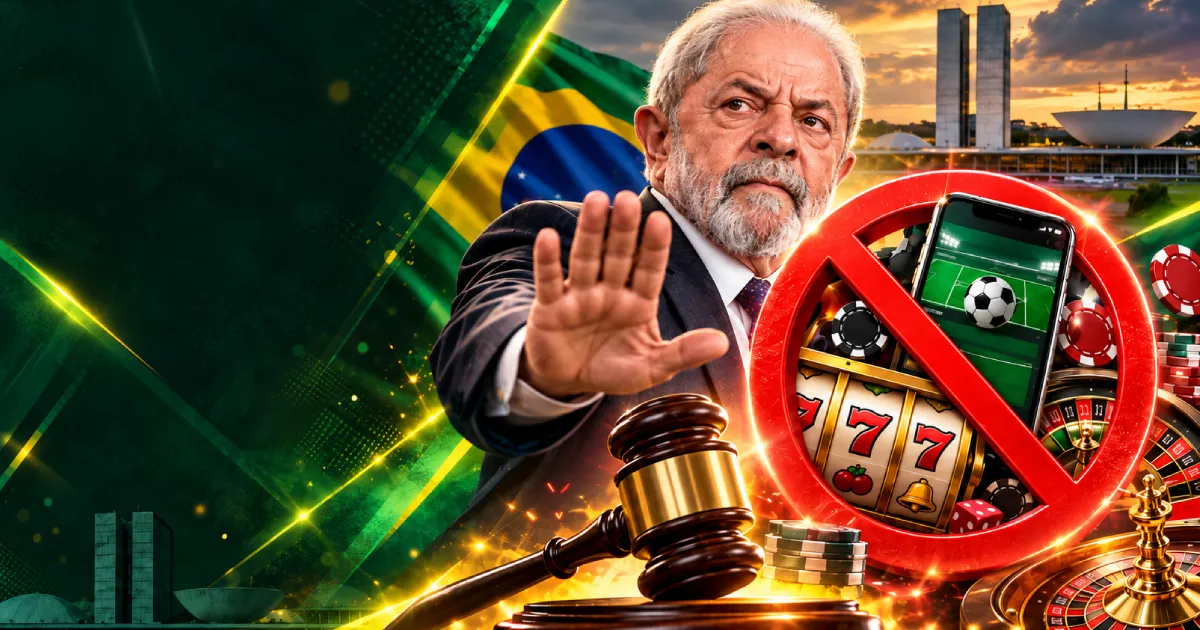
The clock has already started ticking. Since the announcement, no platform can accept a new bet in Brazil. October 5th is the deadline for users to withdraw funds from their accounts, on the 6th, websites and applications must be shut down, and from the 9th to the 14th, banks operating with these companies will have to return money to those who were unable to withdraw it.
That is the wording of the provisional measure that Luiz Inácio Lula da Silva announced on Friday, September 25th, which abruptly ends the regulated online sports betting and casino market that had begun operating in 2025.
The chosen instrument has a peculiarity: it takes effect from the moment it is published. However, to become law and definitive, it needs to be debated by the National Congress within 60 days, a period that allows for an extension of another 60 days. Deputies and senators can leave it as is, modify it, or reject it.
The MP does not come alone. Lula also sent a bill to Congress that establishes penalties of up to six years in prison for those who operate or promote fixed-odds betting, presented as a tool against illegal gambling. This text, unlike the measure, does not have immediate effect: it depends on parliamentary approval and subsequent presidential sanction.
The political calendar explains the timing. There are just over seven days left until the first round of the presidential election on October 4th, and Lula has made the fight against betting one of his campaign banners in a close contest with Flávio Bolsonaro. His arguments are household debt and the impact on mental health.
The numbers supporting this discourse exist, although they are open to discussion. The National Confederation of Trade in Goods, Services, and Tourism (CNC) measures that 82 percent of Brazilian families are in debt, an all-time high, and the sector rejects that gambling is the main cause of this situation. On the other hand, the Ministry of Health records an increase of nearly 140 percent in requests for treatment for online gambling addiction over the last five years.
What is being shut down has a precise scope. There were 85 companies licensed by the Ministry of Finance and 188 authorized sites, as each license allows up to three domains. Each company paid R$30 million for an authorization that was supposed to last five years. These platforms had 43.8 million registered bettors, according to data published by Folha de S.Paulo. The total GGR was around R$37 billion in 2025, and the sector estimates about 15,000 direct and indirect jobs tied to the activity.
Cutting these licenses prematurely is probably the point that will cause the most controversy. It is already anticipated that the affected companies will challenge the constitutionality of the measure and its effects in court, relying on authorizations granted by the State itself, the fees paid, and the contracts signed while the market was in force.
The cut also affects the entire chain. Operators had agreements with game providers, sports clubs, technology companies, payment processors, advertising agencies, television channels, and law firms, all contractually linked to an activity that will cease to exist.
Football is the most visible casualty. Fourteen of the twenty Serie A teams currently display a sportsbook on the front of their jerseys: Flamengo with Betano, Corinthians with Esportes da Sorte, Palmeiras and Vasco with Sportingbet, Atlético-MG with H2Bet, Botafogo with VBet, Santos with Novibet, São Paulo and Fluminense with Superbet, Cruzeiro with Betnacional, Vitória with 7K, Remo with VaiDeBet, Chapecoense with ZeroUm, and Grêmio with Pitaco. Last week, the clubs had signed a joint statement warning that an abrupt change would compromise existing contracts, financial planning, and essential revenues.
The scope extends beyond jerseys. Transmission agreements, stadium perimeter advertising, and naming rights are also affected. Two venues from the 2014 World Cup, Arena das Dunas in Natal and Arena Fonte Nova in Salvador, were named after a sportsbook, and the Brazilian Football Confederation (CBF) itself had granted Betano the naming rights for the Brasileirão and the Copa do Brasil.
The other account that is being cut is the fiscal one. In 2025, the year the regulated market began, the sector contributed approximately R$9.95 billion in taxes to the Federal Government. Between January and August 2026, it had already paid R$9.91 billion, practically the same as in the entire previous year. With the prohibition, this flow is interrupted.
The sector's response came en masse. Nine entities signed a joint manifesto in defense of the regulated market: ABC-Bet, ABFS, ABRAJOGO, AIGAMING, AMIG, ANJL, IBJR, IJL, and SINDIBETS. Their central argument is that prohibition does not erase demand but rather shifts it. "No gambling" does not exist, they argued, and warned that a portion of the public will end up playing on platforms that do not meet any of the requirements of the authorized market.
The decision closes a cycle that began in 2018, when Michel Temer legalized sports betting without mentioning online casinos, which nevertheless began to be offered. That law gave the State a maximum of four years, two extendable by another two, to write the rules, a period that was entirely consumed during Jair Bolsonaro's presidency without regulation being achieved. Only in December 2023, with Lula already in his third term, did Congress approve Law No. 14,790, which established the fixed-odds regime and incorporated online games. In 2024, the Secretariat of Prizes and Betting (SPA) was created within the Ministry of Finance, responsible for authorizing, supervising, and sanctioning, as well as the National Secretariat of Sports Betting and Economic Development of Sport, under the Ministry of Sport, dedicated to the integrity of competitions.
If the prohibition holds, Brazil would become an anomaly among the world's major economies: without physical casinos and without a legal online market. What happens now depends not only on the published text but also on how Congress handles it and what the courts decide.
Tags: Brazil betting ban, Provisional measure, Law 14.790, Serie A sponsorships