IBIA projects 60 percent of Brazilian spending in the illegal channel
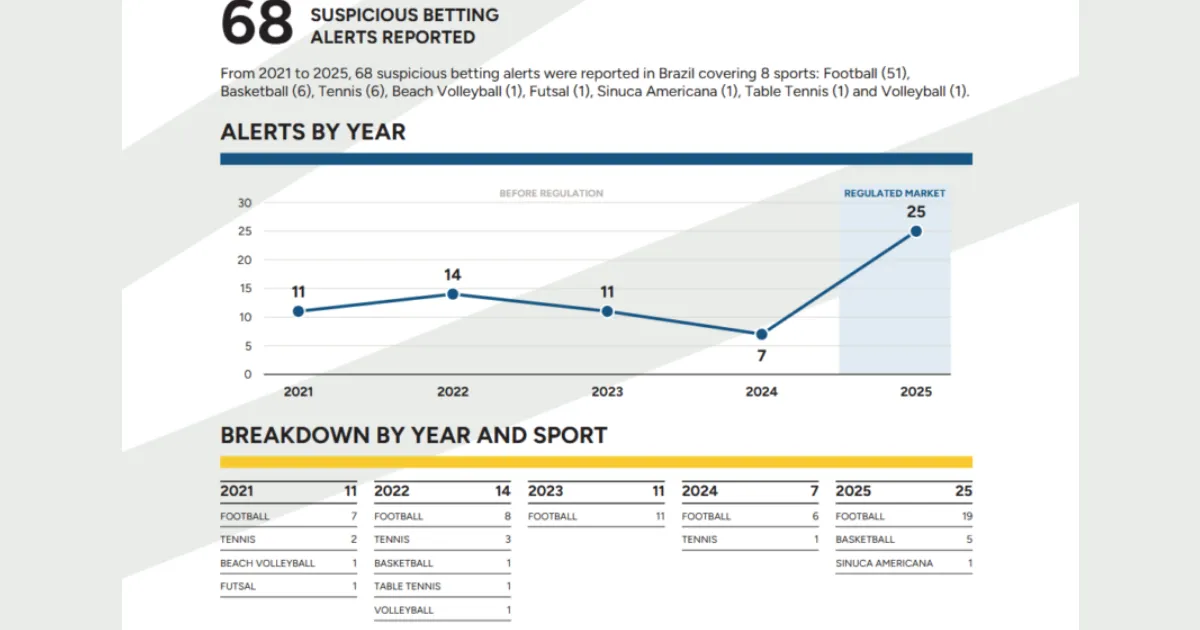
The International Betting Integrity Association has put numbers to the cost that a Brazilian ban would have on sports integrity. Its analysis, built on alert data, market estimates, and regulatory assessments, argues that the departure of licensed operators leaves sports, consumers, and the treasury in a worse position than before the regime that the decree of September 25, 2026, came to dismantle. The closure came 21 months after the market opened, licenses expire on October 25, and Congress has 120 days to ratify or overturn the regulation.
The entity begins by recalling what that regime had built. In less than two years, Brazil authorized more than 80 operators, required identity verification for each customer, activated a national self-exclusion system, and blocked illegal sites and payments, with the added obligation to monitor suspicious bets, report them, and adhere to an independent integrity body. Measured with the association's own methodology, the framework prior to the ban scored 77 out of 100, above Portugal with 68 and below Great Britain with 86, a high rating for a newly opened market.
The data that best illustrates the argument is that of alerts. During 2025, the first full season with the regulated market, the association registered 25 alerts about suspicious movements in Brazilian sports, compared to an annual average of 11 in the four-year period from 2021 to 2024. The jump does not describe more manipulation but better detection, because licensed operators were obliged to identify and communicate every strange movement. Alerts are indications and not proof of match-fixing, so a future drop in the number will not mean healthier sports but a smaller volume of information with which to investigate it.
There lies the fundamental problem raised by the entity. Without licensed operators, no one is obliged to report, which means the trail of evidence disappears, and both sports sanctions and criminal cases become more difficult, in a country where match-fixing is a typified crime and where monitoring by regulated bookmakers supported recent convictions and sanctions. Patterns that could previously be detected, analyzed, and passed on to regulators, federations, and law enforcement become much harder to obtain.
Regarding the size of the displacement, the association cites estimates from H2 Gambling Capital. Without a licensed alternative, some R$25,000m (US$5,000m), equivalent to about 60 percent of spending, would shift to unlicensed operators, and the illegal circuit would jump from about R$17,000m (US$3,377m) to around R$42,000m (US$8,343m). The cost is not limited to lost revenue, because the migrating player leaves behind payment protections, self-exclusion tools, and identity controls, while the State foregoes taxes and license fees, top-tier clubs lose the sponsorship that financed them, and authorities lose access to betting and account data that licensees were obliged to provide.
The final request is directed at Congress. The association demands that Provisional Measure 1.394/2026 be reconsidered and that the future of the market be decided through the ordinary legislative process, with a published impact analysis, an explicit risk assessment, and open dialogue with the sector. It admits that the regime had gaps in advertising, consumer protection, operator supervision, and the prosecution of illegal providers, but argues that these shortcomings are reasons to correct the regulation and not to abandon it, with oversight focused on unauthorized entities and gambling harms addressed with specific tools within a regulated market.
It is worth comparing this estimate with what the State itself has been reporting, because both measure the same migration with different units. The Government counts blocking orders, 16,627 sites between September 25 and October 9, and the local sector association speaks of 30,000 active illegal pages, while this report quantifies money and not domains, R$25,000m changing hands. The two series are compatible and describe the same phenomenon from opposite ends, although none of the three figures comes from an official measurement of spending. The internal arithmetic of the report adds up: the base R$17,000m plus the displaced R$25,000m gives the projected R$42,000m, but the dollar conversions in the text itself use slightly different exchange rates between figures, so the comparison in US currency should be taken as a reference and not as hard data.
Tags: IBIA, betting ban in Brazil, sports integrity, illegal market