Chile confirms that the effective tax burden on online gambling will be 22%
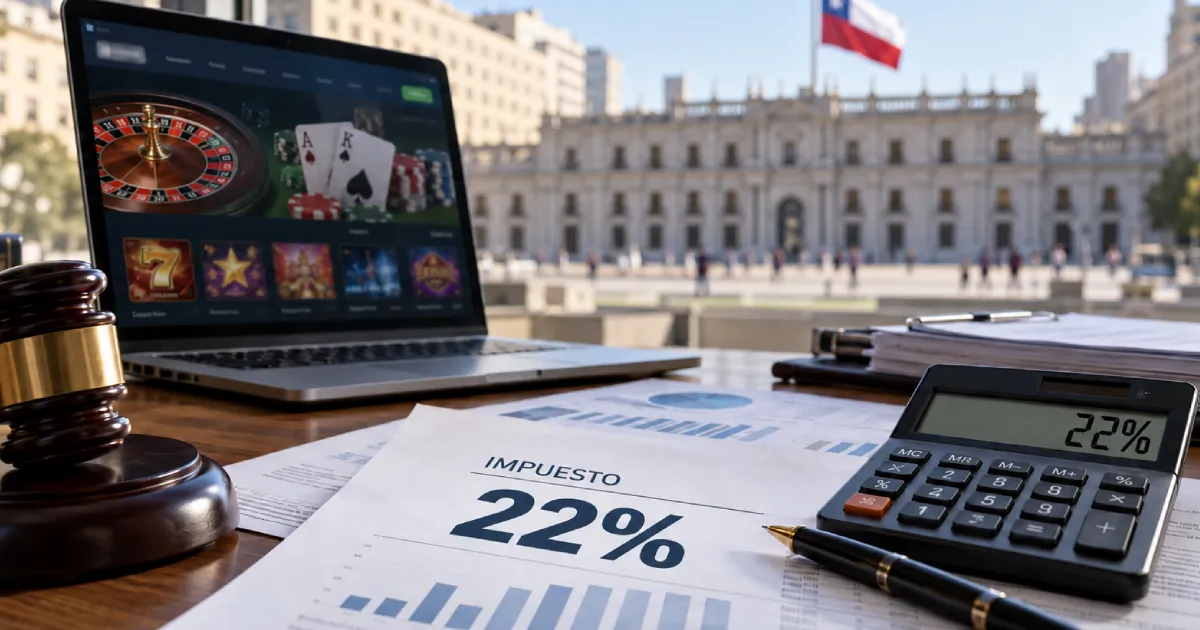
The most significant ambiguity in the Chilean bill was resolved this week in the Senate. Undersecretary of Finance Sebastián Vallebona explained before the Economy Committee that the 3 percent specific tax rate will be applied without allowing deductions for VAT or Monthly Provisional Payments (PPM), meaning the effective tax burden—combining the 19 percent VAT—reaches 22 percent of gross gaming revenue (GGR). This was the central question left open by the text, and the answer represents the more onerous of the two possible interpretations.
The official made sure to dispel the narrative portraying the change as a tax cut. "With this change, there is no tax reduction from 20% to 3%, as these are different tax bases," he argued, defending the new framework on the grounds that it ensures predictable taxation that is easy to audit.
To understand why 3 percent does not equate to a cut from 20 percent, one must look at what the previous draft proposed. That framework treated online gambling as a digital entertainment service subject to VAT, which allowed operators to offset VAT paid on goods and services as tax credits, while adding a 20 percent specific tax—identical to that of land-based casinos—with the ability to deduct both VAT and PPM, plus an additional percentage point earmarked for responsible gambling that also allowed deductions for expenses incurred. In other words, the nominal rate was six times higher, but the taxable base was significantly smaller.
The full package currently under discussion consists of four components. In addition to the 22 percent effective rate, there is a 1 percent gross revenue contribution to responsible gambling—this time calculated after deducting VAT and PPM—the annual license fee of 1,000 UTM already included in the original text, and direct state funding for a new Problem Gambling Fund totaling 60,000 UTM over three years. This last point received the least attention and is worth highlighting: the problem gambling fund is financed with public money rather than solely by industry contributions, and 60,000 UTM is equivalent to sixty times the annual license fee.
Revenue projections are the other major development. Vallebona estimated that the new structure will exceed USD 100 million in its first year and reach USD 133 million after five years of implementation, figures he compared to the USD 84 million annually projected under the previous bill. The increase over that earlier estimate is 19 percent at the outset, and the five-year trajectory implies a 33 percent growth compared to year one.
From these figures emerges an estimate that the government did not state explicitly. If the effective tax burden is 22 percent of gross gaming revenue and first-year tax collection surpasses USD 100 million, the administration is projecting an annual GGR for the Chilean online channel of approximately USD 455 million, rising to around USD 605 million by year five. This marks the first official figure providing a sense of the scale the state attributes to a market it has yet to regulate.
These numbers enable a comparison that is worth examining alongside the grievance made public two days ago by the Chilean Gaming Casino Association (Asociación Chilena de Casinos de Juego). Land-based casinos pay a 20 percent specific tax on gross gaming revenue after deducting VAT and PPM, whereas the online channel would pay 22 percent without any of these deductions. If the bill advances under these terms, the tax asymmetry denounced by the association would be reversed: the online sector would bear the heavier tax burden of the two channels, not the lighter one.
Regarding advertising, Vallebona confirmed stricter regulations and justified them from an unexpected angle. He stated that the amendments tighten user identity verification to ensure continuous and ongoing oversight, framing the advertising ban within that same objective, accompanied by administrative and criminal penalties. He also recalled that the previous version of the bill was limited to restricting advertising, whereas the current text moves toward an outright ban across all platforms and economic sectors. The only door left open is temporary: "A transitional rule is established allowing platforms that choose to regularize their status to maintain advertising for one year," provided the contract was signed prior to the law's enactment.
That justification is the missing piece needed to understand the regulatory design. By presenting the advertising ban as an identity verification tool rather than merely a safeguard against problem gambling, the government proactively counters the channelization argument raised by industry associations this week: if the stated objective is for the state to know at all times who is playing, the commercial visibility of the licensed operator becomes secondary. The two rationales—channelization versus identification—target different forms of protection, and the bill chose the latter.
The UTM is the Monthly Tax Unit (Unidad Tributaria Mensual), an inflation-adjusted index used in Chile to express fines, levies, and tax obligations, ensuring the amounts in the bill adjust for inflation without requiring legislative amendments. The PPM is the Monthly Provisional Payment (Pago Provisional Mensual), an advance income tax payment made monthly by Chilean companies. The 114-page bill is currently being debated in the Senate Economy Committee and proposes five-year licenses in a market that has operated without its own legal framework, under tax pressure from the Internal Revenue Service (Servicio de Impuestos Internos) and court-ordered blocking.
Tags: Chile, Taxes, Vallebona, Regulation