Colombia proposes VAT on bettor deposits
It is worth starting with what has not yet happened. The Colombian government introduced a tax reform bill on October 29, meaning none of the measures it contains are currently in force or have an effective date. Congress must debate it and can amend, remove, or reject the articles related to gaming, as already occurred in 2024 and 2025 with previous initiatives of a similar nature.
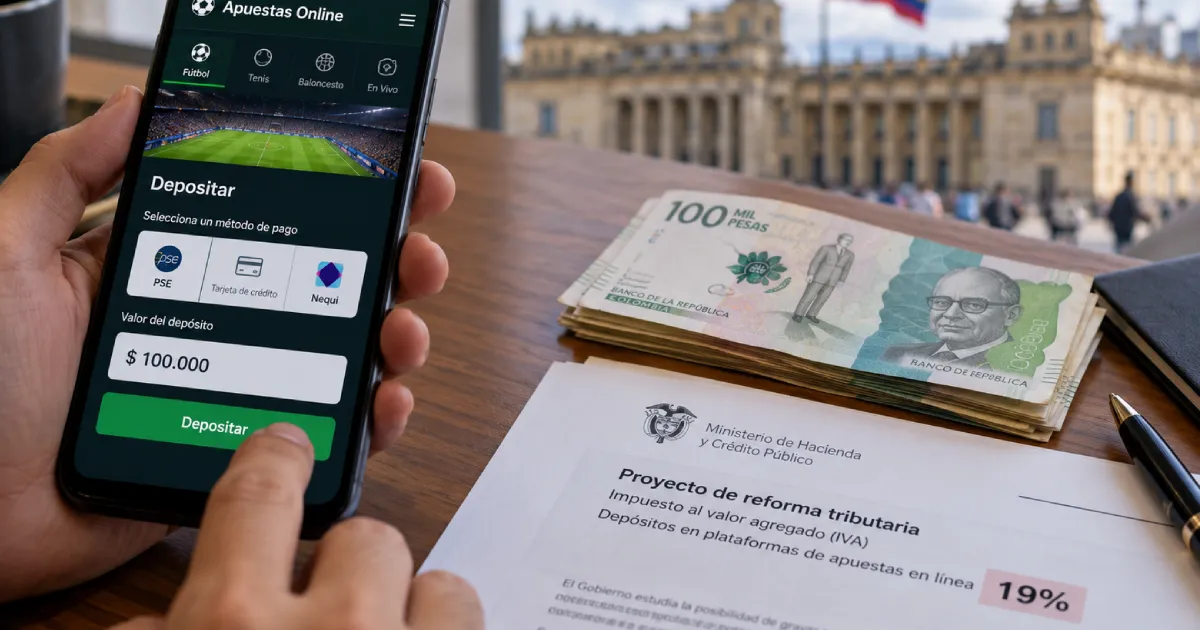
Within this bill, there is a proposal that warrants attention because of its structure rather than its rate. Article 41 of Bill 477 of 2026 proposes that games of chance be taxed at the standard VAT rate of 19 percent, and that for online betting, the taxable base be calculated on deposits made by players into their accounts—in cash or crypto assets—divided by 1.19. Traditional lotteries would be exempt.
That formula translates into an arithmetic calculation that helps put the proposal into perspective. Dividing deposits by 1.19 and then applying the 19 percent rate would be equivalent to withholding 15.97 percent of all funds entering gaming accounts, regardless of how much of that money is ultimately returned to the player in prizes or withdrawals. The decree struck down by the Constitutional Court earlier this year levied a 19 percent tax on gross gaming revenue (GGR)—that is, the difference between amounts wagered and payouts. For the two tax burdens to match, gross gaming revenue would have to account for 84 percent of deposits, a proportion that no online casino operator records. If the bill were approved as drafted, the effective burden on the online vertical would be significantly higher than that of the scheme already ruled unconstitutional.
For land-based gaming, the proposal moves away from the revenue discussion and establishes monthly tax bases expressed in Tax Value Units (UVT). Each slot machine would be taxed on 40 UVT, each gaming table on 580 UVT, and each bingo seat on six UVT. The implicit hierarchy is clear: one table would be equivalent to 14.5 slot machines and nearly 97 bingo seats, effectively defining in advance which format would bear the brunt of the tax.
The initiative is titled the Economic Rescue Law and was introduced by the administration of Abelardo de la Espriella, endorsed by Minister of Finance Miguel Gómez, Vice President José Manuel Restrepo, and Iván Cancino, acting Minister of Justice and the Interior. The stated goal is to raise approximately COP 40 trillion and rein in the growth of public debt. A methodological caveat is in order: the dollar conversion circulating alongside that figure does not align with its magnitude, as was also the case with the failed 2025 bill, meaning any comparison between both amounts should be made in Colombian pesos.
Gaming is a minor component within a much broader package. The reform would keep the standard VAT rate at 19 percent while expanding the range of goods and transactions subject to it, alter income tax, eliminate tax exemptions, modify the taxation of alcoholic beverages and beer, change the import regime for vehicles, motorcycles, and electrical equipment, phase out the reduced 5 percent rate starting in 2028, and be accompanied by cuts in public spending.
Recent history explains why the sector views this text not as a novelty, but as a rerun. In 2024, the administration of Gustavo Petro attempted a tax reform in which gambling was ultimately excluded from the final text. In February 2025, the executive branch imposed the levy by decree under the legal framework of an internal commotion (state of unrest), which authorizes exceptional measures to maintain public order. Fecoljuegos measured the impact of that emergency measure: between March and June of that year, real operating revenues for the online channel dropped by 32 percent.
In December 2025, the Senate's Fourth Commission rejected, by nine votes to four, the reform bill intended to fund the 2026 National General Budget with an estimated collection of COP 16.3 trillion, which had once again included VAT on gambling. Shortly thereafter, the Executive issued Decree 1474 of 2025 under an economic emergency declaration, introducing a framework that taxed online gross gaming revenue at 19 percent. The decrees took effect on January 1, 2026, and were declared unconstitutional by the Constitutional Court.
The outcome of this trajectory is that the tax has failed twice in Congress and once in the courts. The difference in this attempt lies in the legislative mechanism: an ordinary law would not face the specific judicial review that overturned the emergency decree, but it must still navigate the very same Fourth Commission that voted against it less than a year ago. Furthermore, the industry enters the legislative debate with a new, concrete argument: this time, the discussion does not center on the tax rate itself, but on a calculation base that, under careful analysis, would increase the tax burden on the online vertical beyond what the Court previously reviewed.
Games of chance in Colombia are regulated by Coljuegos, an entity under the Ministry of Finance that grants and oversees market concessions, including those for online operations authorized by the country in 2017. Revenue generated by the sector is specifically earmarked for the public healthcare system. The Tax Value Unit (UVT) is the benchmark used by Colombian tax authorities to establish fiscal obligations and is updated annually, meaning that bases defined in UVT adjust automatically without requiring legislative amendments. Fecoljuegos is the trade association that represents operators across the industry.
Tags: Colombia, Online gambling VAT, Law 477 of 2026, Tax reform